


This post was last updated on 3/14/2024
From the time they’re born, kids learn about their environments and the world around them through sensory play.
Sensory play includes just about any activity that stimulates a child’s senses through new and exciting experiences. Research shows that sensory play in the early years of child development helps build neural pathways that will be needed for more complex learning tasks as your child grows.
Overall, the benefits of sensory activities for early childhood development are well-established. Sensory play also supports language acquisition, cognitive development and problem-solving, social interaction and emotional skills, and both fine and gross motor skill development. While expanding their own skills and capabilities, kids also start to develop knowledge about objects and materials in their surroundings.
In this blog, we list some of our favorite sensory activities for infants and toddlers across all seven senses of the human body. We’ll also explain how each activity works and which areas of sensory development receive the greatest benefits.
What are the Seven Senses?
Many of us grew up learning about the five senses of the human body, but some of us are surprised to learn that there are really seven senses that kids must develop to maximize their wellbeing in life. These include:
- Seeing – Recognizing colors, shapes, letters, words, numbers, body language and other cues in the environment.
- Smelling – Recognizing and identifying different foods, plants or materials in the environment.
- Hearing/Listening – Recognizing sounds in the environment, understanding what they mean and learning how to respond.
- Touching – Recognizing different textures, learning to identify objects by their shape and material, and differentiating between objects that are safe and not safe to touch.
- Tasting – Recognizing different tastes and the foods they belong to, identifying good and bad tastes.
- Balancing – Perceiving body movements in relation to gravity and weight, learning movements to maintain balance and prevent falling.
- Body Awareness – Recognizing the position of the body and how it moves in three-dimensional space, exercising greater control over the body.
With these seven senses in mind, let us explore 20 different sensory activities –10 for infants and 10 for toddlers – that parents and child care providers can use to encourage learning through sensory exploration and play.
10 Sensory Activities for Infants
Hanging Mobile
Overview: A hanging mobile over a baby’s crib isn’t just for decoration, it provides an early source of visual stimulation and sensory play that helps your infant develop vision skills.
Why it Works: Infants in the crib need visual stimulation to develop vision skills – they need something interesting to look at. A hanging mobile provides a bit of color, motion and reflection in their environment that stimulates the eyes and mind. Parents and child care providers should replace the hanging mobile every few months and play with the baby by touching or moving the mobile to capture their attention.
Sensory Development: Seeing
Smiling Faces
Overview: Take out family photo albums and show your infant child pictures of smiling faces. Point to the faces in each picture so your child notices the smiles. If you have family pictures on the walls at home, look at them together with your child.
Why it Works: Before kids are old enough to understand words, smiles represent a loving response that helps your child feel safe and secure in the world. Learning to recognize smiles in their environment helps kids develop their sense of security and belonging while building their visual skills.
Sensory Development: Seeing
Singing Songs
Overview: Singing songs together with your child can help them develop listening skills from an early age.
Why it Works: Singing with your child offers a range of sensory development and cognitive benefits. Kids develop their listening skills by hearing you sing and trying to mimic. They also learn concepts like tone and rhythm and develop their language skills.
Sensory Development: Listening
Mirror Games
Overview: Play mirror games with your infant. Position a mirror so they can see their own face or body and interact with their reflection. Help them learn that the reflection in the mirror is theirs.
Why it Works: Infants are in the process of developing self-awareness and learning more about their environments. Mirror games can help infants develop their visual skills. As they get older, play by asking them to point to their eyes, ears or nose, or practice making funny faces.
Sensory Development: Seeing, Body Awareness
Sensory Bottle
Overview: To make a sensory bottle, take an empty water bottle and fill it with materials of your choice, then use non-toxic glue to secure the cap and prevent spills.
Why it Works: Sensory bottles can provide diverse sensory experiences for kids based on what you choose to put inside. Marbles, sequins and glitter mixed with water provide a sparkly effect like a snow globe that’s visually stimulating. Kids play with the sensory bottle by holding, turning and shaking it.
Sensory Development: Seeing, Touching
Texture Board
Overview: A simple texture board with different materials can provide diverse sensory stimulation as infants develop their sense of touch.
Why it Works: Kids learn about their environments through the five senses – especially touch. New textures are exciting for infants who have never experienced them before. Experiment with different materials for your texture board, including cotton balls, tin foil, felt paper, string, beads, rocks, shells, leaves, buttons, sponges and wood.
Sensory Development: Touching
Sponges and Water
Overview: A small tray with water and a few sponges make a fun sensory activity for your infant child.
Why it Works: Sensory activities for infants need to be fun, safe, and simple – especially at the age where kids learn by putting things in their mouth. Sponges and water tick all the boxes here – your baby can splash in the water, practice picking up and squeezing sponges, and have fun getting wet as they develop their body awareness, object exploration skills, and sense of touch.
Sensory Development: Touching, Body Awareness
Ice Cubes in a Bowl
Overview: A handful of ice cubes in a baby-safe bowl with some water is a simple and fun activity with plenty of opportunities for sensory development and early learning.
Why it Works: Your infant can have fun splashing in the water, develop their fine motor skills by grasping slippery ice cubes, and feel the difference between warm and cool temperatures. As kids get older, they can learn about phase changes (melting and freezing), floating and sinking objects, air bubbles in the water, and more. Kids love doing sensory activities with ice and water, and parents love the low cost, minimal clean-up requirements, and rich learning opportunities these materials can provide.
Sensory Development: Seeing, Touching
Musical Toys
Overview: Simple musical toys help your infant develop an interest in musicianship as they develop their motor skills and senses of listening and touch.
Why it Works: Listening to music helps kids develop their sense of hearing, but playing a toy instrument helps a child develop agency, release pent-up energy and build their creative skills. Learning to play with different instruments like a xylophone or baby guitar helps develop coordination and sense of touch.
Sensory Development: Touching, Listening
Make Oobleck with Cornstarch and Water
Overview: Mix a cup of water with around two cups of cornstarch and you’ve got Oobleck – a special type of fluid that’s rock-hard when you squeeze it but runs like water when you let go.
Why it Works: Oobleck is fun to make and fun to play with. Kids can grab it and squeeze it to feel it become hard in their hands, then release their grip and watch it flow back into the container. In doing so, they develop the sense of touch, fine motor skills, and experience new textures. Oobleck is also safe for kids to put in their mouth (though it doesn’t taste good and could hurt their tummy if they eat too much).
Sensory Development: Touching, Tasting, Seeing
Free Report
2023 Child Care Industry Trends Report
We conducted an email survey of more than 100,000 child care leaders and teachers. See what they had to say about the current state of the industry.

10 Sensory Activities for Toddlers
Smell & Guess
Overview: Parents hide scented materials in opaque containers. Toddlers are encouraged to smell the inside of the container without looking and guess the smell.
Why it Works: Smell & guess is a novel and exciting game for young kids who love to learn while being challenged. Scented oils like lavender, vanilla extract and peppermint extract can be used, along with fresh items like cinnamon sticks, garlic, lemons, vinegar, flower petals or ginger.
Sensory Development: Smelling
Pretend Tightrope
Overview: Pretend tightrope is a simple game to help toddlers develop a sense of balance. Parents set down a rope or string on the ground and toddlers play by walking in a straight line along the string without stepping off.
Why it Works: Toddlers are growing rapidly, starting to walk, and ready to explore and interact with the environment in new ways. Pretend tight rope is a fun game that promotes body awareness and builds your child’s skills and confidence for more difficult physical activities in the future.
Sensory Development: Balance, Body Awareness
Salt Tray Writing
Overview: A tray full of salt is a great way for toddlers to practice drawing shapes and making letters as they develop visual/spatial skills, language skills and sense of touch.
Why it Works: When toddlers start to recognize symbols like shapes and numbers, a salt tray can help them practice drawing those symbols before they learn to work with a pencil and eraser. They can use a “magic wand” to draw in the salt, or just trace with their finger. A little shake of the tray spreads out the salt so they can start again.
Sensory Development: Touching, Seeing, Language
Finger Painting
Overview: Finger painting gives your toddler the opportunity to use their imagination and be creative while learning through sensory experience.
Why it Works: Finger painting incorporates many different senses. They develop their sense of vision by choosing colors. They develop the sense of touch while mixing paints by hand. They use vision and touch while painting a picture. They develop the sense of hearing by listening to parents for help and feedback. They also develop fine motor skills, coordination, and creativity skills.
Sensory Development: Touching, Seeing, Listening
Sandbox Games
Overview: Sandbox games include things like building a sand castle or moving piles of sand with scoops, buckets, shovels and other toys.
Why it Works: Toddlers are learning how to manipulate their environment and surroundings using different tools. Parents can encourage play by hiding objects in the sand for toddlers to find or teaming up to build a sandcastle.
Sensory Development: Touching
Sensory Table
Overview: A sensory table is a surface with bins that parents can fill with different objects to provide sensory learning opportunities for their young kids.
Why it Works: Sensory tables are versatile. Parents can choose objects by color (yellow objects – a banana, a lemon, dandelion flowers, yellow felt or cloth balls, a rubber duck, etc.), or by type (nature objects – leaves, bark, pinecones, dirt, grasses, flowers, pebbles). Parents can even create sensory tables with edible objects so toddlers can learn by tasting.
Sensory Development: Seeing, Touching, Tasting
Rice or Pasta Bin with Scoop
Overview: Bins of rice or pasta with scoops and shovels of different sizes are a fun way for toddlers to develop the sense of touch.
Why it Works: Kids love to shovel, scoop and dump objects as they develop motor skills and sense of touch. Parents can provide scoops and buckets of different sizes to help toddlers learn that heavier objects require more effort to move. Using cooked (and cooled) pasta or rice can make this sensory activity edible and even more fun for kids.
Sensory Development: Touching, Tasting
Simon Says
Overview: Simon Says helps kids develop their listening skills and body awareness in a fun and competitive context.
Why it Works: At the toddler age, kids learn best by playing. Simon Says is a game that develops a child’s listening and body awareness skills. They’ll learn to listen carefully, follow instructions and engage their attention, focus and short-term memory.
Sensory Development: Listening, Body Awareness
Freeze Tag!
Overview: Freeze tag is a popular playground game where a person who is tagged must “freeze” in their current position, not moving until a team member comes to save them.
Why it Works: Freeze tag encourages kids to develop social skills and integrate physical activity into their daily lives. Having to freeze in place when they’re tagged encourages kids to experiment with their balance in new positions and develop body awareness that will help them succeed in more complex physical activities later in life.
Sensory Development: Balance, Body Awareness
Make Popcorn
Overview: Making popcorn with your toddler is a fun and safe activity where they’ll learn valuable life skills – and when it’s finished, you’ll have a tasty snack to share.
Why it Works: Making popcorn with kids incorporates multiple kinds of sensory experiences. Show kids what the kernels look like before and after going into the microwave. Kids can smell the popcorn while it cooks and listen to the popping sounds. Once the popcorn is made, they’ll enjoy touching and tasting it as well – just make sure to let it cool down first.
Sensory Development: Hearing, Touching, Seeing, Tasting
Sensory Activities FAQs
How can teachers adapt these sensory activities for children with sensory processing disorders or special needs?
Adapting sensory activities for children with sensory processing disorders or special needs can involve modifying the activity to suit the child’s sensory preferences and sensitivities. This could include providing alternative materials with different textures, adjusting the intensity or duration of sensory input, or incorporating sensory tools. It’s important for caregivers to consult with professionals such as occupational therapists for personalized guidance tailored to the child’s specific needs.
Are there any safety precautions or considerations to keep in mind when engaging in these sensory activities with infants and toddlers, particularly regarding materials used or supervision required?
Safety precautions are essential when engaging in sensory activities with infants and toddlers. Teachers should ensure that materials used are non-toxic and age-appropriate to prevent choking hazards or other accidents. Close supervision is necessary, especially during activities involving water, small objects or potential allergens. Additionally, parents should be mindful of any sensory sensitivities or medical conditions that may impact the child’s participation in certain activities, and adapt accordingly to ensure a safe and enjoyable experience.
Power Your Child Care Center with Procare Solutions
Procare is proven in the business of child care, with over 30 years experience delivering child care products and services that enhance outcomes for child care centers, educators, and the families and kids they serve.
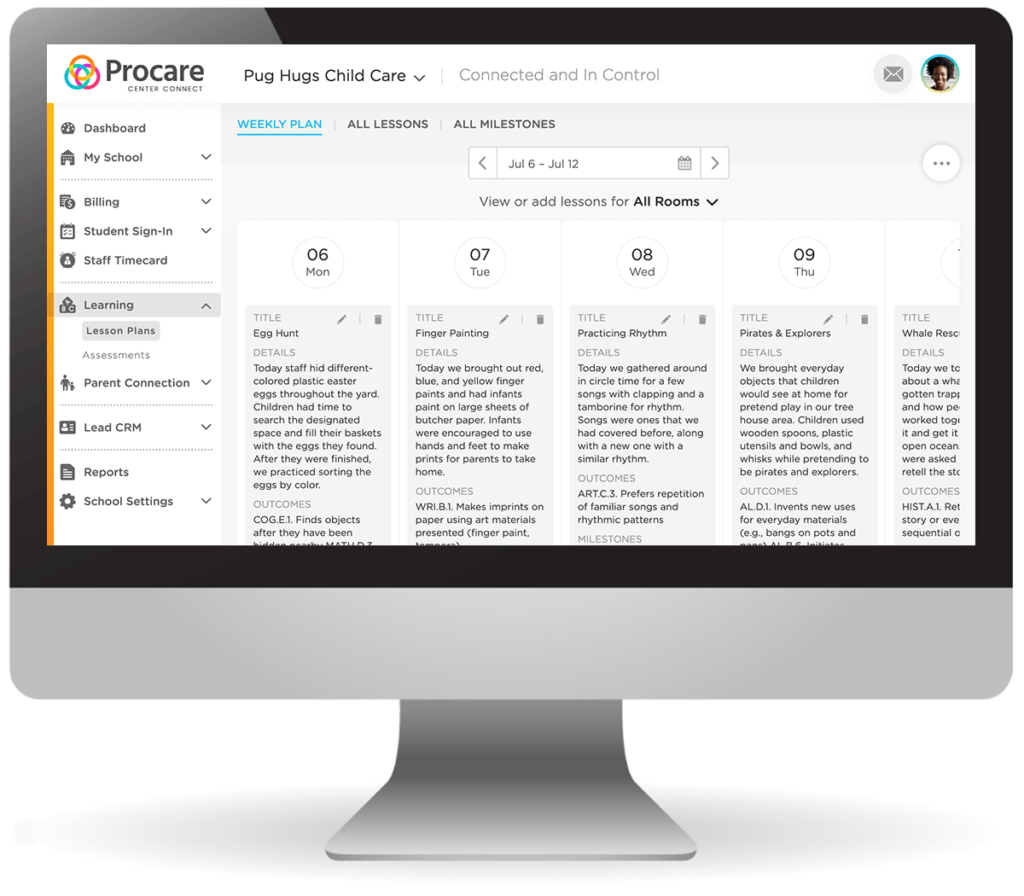
With Procare Solutions, child care providers can plan lessons and schedule sensory activities, ensuring that each child in their care develops all seven senses through stimulating play. Using the Procare app, parents can follow their child’s progress and track observations in real time as they discover the world through sensory play.
With features like our integrated child care billing software, daily observation sharing through our family engagement platform, weekly lesson planning and child development portfolios, Procare is the leading child care management solution for centers of all sizes.
Ready to find out more?
Request a Demo
Talk with a friendly Procare expert to get a tailored child care solution for the unique needs of your business.