
This blog was originally posted on Sept. 17, 2019, and was updated on March 19, 2026 with new activities and other information.
As the beginning of a new school year approaches, it’s time to start planning small group activities for preschoolers! Small group math activities for preschoolers, as well as small group literacy activities for preschoolers, are extremely beneficial to this age group.
By splitting up your class into groups of five to six children, you can set up various “stations” throughout the classroom, which groups rotate through. Small group activities are extremely beneficial to early childhood learning and development.
Preschool-aged children are still developing social and cognitive skills and often have an easier time in a small group setting where there is less stimulation and the opportunity to get more attention from peers and teachers. As they play and engage with other children, they develop skills like cooperation and sharing while socializing and developing their own interests — all important areas to work on before kindergarten comes around.
If you are looking for fresh ideas that will maximize learning and development, consider implementing these small group activity ideas for preschool into your daily schedule.
10 Small Group Activities for Preschoolers
1. Fine Motor Skills with Scissors
The development of fine motor skills is very important for preschoolers. Fine motor skills involve the use of small muscles that control the hand, fingers, and thumb which helps children perform important daily tasks like feeding themselves, buttoning and zipping clothes, drawing, holding toys, and more.
Allow children to practice their fine motor skills by drawing lines and shapes on paper – then, make copies to pass around. Children can use safety scissors to cut across the lines to the best of their ability.
Another fun option? Download our free small group shape-cutting and puzzle activity sheet. Children will first cut out the puzzle pieces using safety scissors. Then, they’ll work as a team to put the puzzle together to reveal a shape, animal or another object.
Educator Tip: Before handing out scissors, take a moment to do a quick “scissor grip check” with the group — show children how to place their thumb in the top hole and two fingers in the bottom, then have everyone practice opening and closing in the air before touching paper. This brief routine builds muscle memory and helps prevent frustration once the cutting begins. For children who are still developing their grip strength, try offering spring-loaded safety scissors, which require less force and can make the experience feel much more successful right from the start!
2. Cooperative Drawing
This activity involves children sitting around a small table, each with their own piece of paper and one marker. Each child writes their name on the paper and then turns the paper over, so the blank side is up.
Instruct the group to begin drawing whatever is in their imagination for 30 seconds. After 30 seconds, each child will pass their paper to the left where the next child will begin drawing for 30 seconds on the new paper.
Continue rotating until the paper is back to their original owners. The children will be pleasantly surprised by how their creations turned out. Each child was able to have their own interpretation of what the drawing was supposed to be when they received a new piece of paper, strengthening their creative expression.
Educator Tip: At the end of the activity, set aside a few minutes for a group “gallery walk” where each child holds up the paper that started with their name and shares one thing they notice or love about what it became. This closing ritual validates every child’s contribution and turns the big reveal into a joyful, confidence-building moment. If you notice any hesitation during the activity — a child unsure of what to draw — a gentle prompt like “Draw something that makes you happy” or “What’s your favorite animal?” can get the pencil moving without putting pressure on the process!
3. Dramatic Play
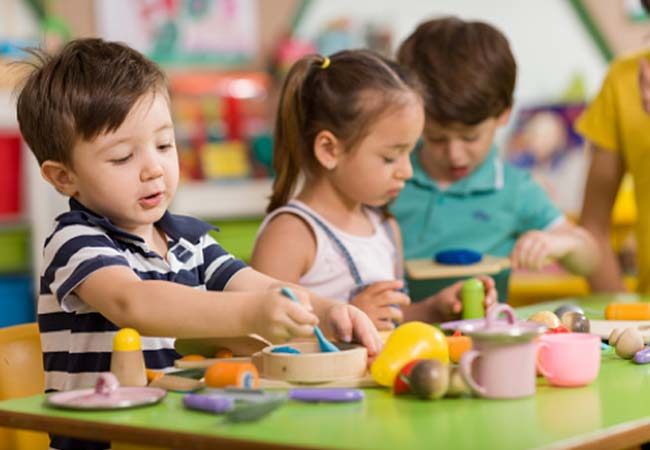
Pretend play is an important part of early childhood development as it allows children to learn by using their imagination and putting their ideas into action. As children engage with one another, social skills are developed. They’ll create unique dialogues with one another and pick up on the basics of successful communication.
Of course, young preschoolers will need some direction on where to start, so it’s a good idea to come up with a theme: Suggest zoo animals, the movie theater, an amusement park, or even a garden shop. Once a theme is established, let them run with the idea and observe the creativity as it develops.
Educator Tip: A simple prop bin can make all the difference in dramatic play. Even a few scarves, hats, empty food containers, or toy tools can instantly spark imagination and help children step into their roles with confidence. Rather than assigning specific parts, let children self-select their roles within the theme, which encourages autonomy and gives you a wonderful window into each child’s personality and social tendencies.

4. Alphabet Letter Matching Game
When searching for small group activities for preschoolers for literacy, this one is great. It helps preschoolers recognize and match uppercase and lowercase letters of the alphabet.
You’ll need a large poster board or chart paper, colored markers or crayons, alphabet flashcards (both uppercase and lowercase) and small stickers or sticky notes.
Create a large poster board or chart paper with the alphabet written in random order, mixing both uppercase and lowercase letters. Use different colors for each letter to make it visually appealing. Also, gather alphabet flashcards with corresponding uppercase and lowercase letters.
Gather a small group of preschoolers and explain that they will be playing a fun game to match uppercase and lowercase letters. Before starting the activity, do a quick warm-up exercise with the children. Sing the alphabet song together or have the kids take turns saying the alphabet aloud.
Show the preschoolers the large poster board with the mixed-up alphabet letters. Demonstrate how to match an uppercase letter with its lowercase counterpart. Use a pointer or your finger to indicate the letters as you talk about them.
Give each child a set of alphabet flashcards. The children can take turns coming up one by one, picking a flashcard, and finding its match on the poster board. Encourage them to say the letter names out loud as they find the matches.
When a child correctly matches a pair of letters, give them a small sticker or a sticky note to place on both the uppercase and lowercase letters to mark them as a successful match.
Allow each child to have multiple turns so that they get enough practice with different letters. If there are more letters than children, you can rotate the flashcards and continue the activity until everyone has had several opportunities to participate.
After all the children have had a chance to participate, gather the group together again and talk about the letters they matched. You can ask questions like, “Which letter was the most challenging to find?” or “Can you name a word that starts with the letter ‘B’?”
For children who are more advanced or show interest, you can extend the activity by asking them to find an object in the room that starts with the letter they just matched.
This activity not only helps preschoolers recognize and match letters but also fosters social interaction, cooperation, and verbal communication skills within a small group setting.
Educator Tip: Pay attention to which letters trip children up most during the activity — letters like b/d, p/q, and m/w are commonly confused at this age and are worth revisiting in future sessions with extra hands-on practice. You can also keep a simple tally of which letters each child matched successfully to help inform your small group literacy planning going forward. For a fun take-home extension, send each child home with a “letter of the week” card and encourage families to go on a letter hunt together — finding that letter on cereal boxes, street signs, or books — which reinforces classroom learning in a meaningful, everyday way!
5. Board Games
Small groups are ideal for introducing simple board games like Candyland or Chutes and Ladders. These classic board games have a lot to offer as they are not only a lot of fun but help with developing problem-solving skills and the opportunity to both win and lose – something that children will have to experience throughout grade school and beyond.
Educator Tip: Before starting any board game, take a few minutes to talk about what it means to be a good sport. Celebrating a friend’s turn, waiting patiently, and handling a loss with grace are all skills worth naming out loud before they’re needed in the moment. If a child becomes upset after losing, use it as a gentle teachable moment rather than moving past it quickly — phrases like “It’s really hard to lose sometimes, isn’t it? What could we try next time?” validate their feelings while building emotional regulation. A

6. Counting and Sorting Buttons
And when you’re searching for small group math activities for preschoolers, consider this activity that helps them practice counting, sorting and basic math concepts.
You’ll need a bag of colorful buttons (different shapes and sizes), small cups or containers (at least one for each child), a large sorting tray or mat (optional) and number flashcards or number cards (1 to 10)
Gather the preschoolers into a small group and introduce the activity. Explain that they will be working with colorful buttons to practice counting and sorting.
Show the children the number flashcards or number cards (1 to 10). Go through each number with them, counting together. Use colorful visuals and encourage them to repeat the numbers after you.
Place the buttons in the center of the group on a large sorting tray or mat. Alternatively, if you don’t have a sorting tray, you can spread them out on a table or the floor.
Instruct the children to sort the buttons by color into individual cups or containers. Encourage them to talk about the colors they are sorting and count how many buttons of each color they have.
After the children have sorted the buttons by color, ask them to sort the buttons again, but this time by size. You can guide them by using phrases like “Can you put all the big buttons in one cup and the small buttons in another?”
Once the buttons are sorted, have the children count how many buttons they have in each cup or container. Ask questions like “Do you have more red buttons or blue buttons?” or “How many yellow buttons do you have?”
Gather the children together and talk about their sorting and counting experiences. Ask them about their observations, such as which color had the most buttons or which size category had the fewest.
For children who are more advanced, you can introduce pattern-making using the sorted buttons. Start a simple pattern (such as red-blue-red-blue) and have them continue it with the buttons.
After the activity, guide the children in cleaning up the buttons and putting them back into the bag.
This hands-on activity not only helps preschoolers with counting and sorting skills but also introduces basic math concepts like color recognition, size comparison and even early pattern recognition for more advanced learners. It encourages collaboration, critical thinking and fine motor skills in a fun and engaging way.
Educator Tip: As children sort and count, make a habit of narrating what you observe using math language. “I see you have three blue buttons and five red ones — which group has more?” This kind of conversational math modeling is one of the most powerful ways to build number sense in young learners. For children who finish the sorting activity quickly, challenge them to create a repeating pattern with their buttons and teach it to a friend, which layers in both math and communication skills. A quick note on safety: always do a button count before and after the activity, and remind children that buttons are for sorting only. This is especially important if your group includes younger preschoolers who may still be mouthing objects!
7. Collaborative Collage Making
Gather a small group of three to five children around a shared piece of poster board and set out a variety of materials like tissue paper, fabric scraps, magazine cutouts, stickers, and glue sticks and let the creativity flow together. Unlike individual art projects, a collaborative collage invites children to negotiate space, share materials, and make joint decisions about what goes where, all of which are foundational social-emotional skills.
Consider giving a loose theme, like “things we love” or “our favorite animals,” to give the group a shared sense of purpose without limiting their imagination. As children work side by side, they naturally begin to communicate — pointing out colors they like, asking a friend to pass the scissors, or complimenting each other’s contributions. This kind of peer interaction is incredibly valuable for building vocabulary and practicing conversational turn-taking in a low-pressure setting.
Fine motor skills also get a great workout as little hands tear paper, squeeze glue, and carefully place each piece onto the board. When the collage is complete, take a few minutes to let each child share something they added. This mini “gallery talk” builds confidence and public speaking skills early on. For a fun variation, try a nature collage using leaves, twigs, and flower petals collected during outdoor time, which adds a sensory and science exploration element to the activity.
Educator Tip: Before the activity begins, briefly model how to ask a friend for materials using kind words — “Can I use the blue paper when you’re done?” This sets a positive tone for sharing and gives children a script they can actually use in the moment. You can also designate a small “sharing tray” in the center of the table where communal supplies live, which naturally encourages children to practice taking turns without it feeling like a rule.
8. Block Building Challenges
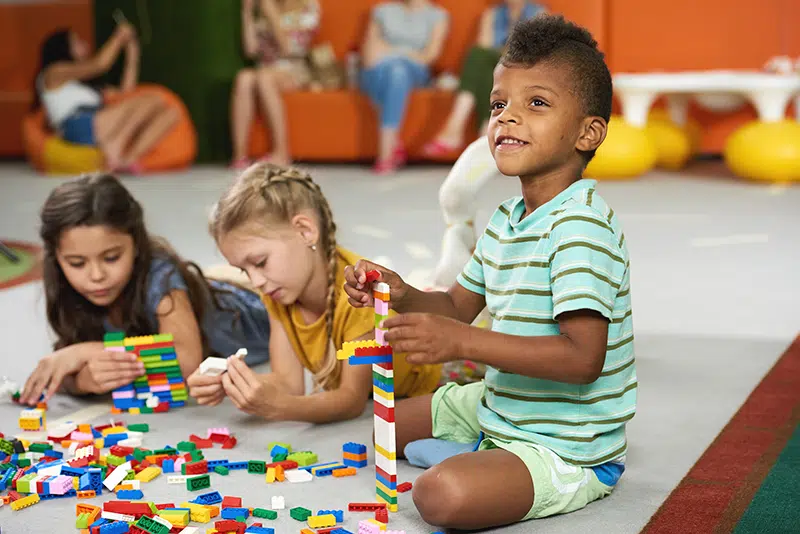
Block play is a classic for good reason, and when you bring it into a small group setting with a simple challenge, it becomes an even richer learning experience. Set up a designated building area with a variety of unit blocks, foam blocks, or DUPLO bricks and give the group a fun mission — “Can you build a tower taller than a water bottle?” or “Let’s build a house big enough for this toy bear.”
The challenge format encourages children to think critically and problem-solve together, testing out ideas and adjusting when something doesn’t work. Spatial reasoning and early math concepts like height, width, balance, and symmetry come into play naturally as children experiment with how to stack and arrange their pieces. Small groups are ideal for this activity because children can collaborate on a single structure, which requires communication, compromise, and a bit of patience when a tower wobbles and falls.
It’s also a wonderful opportunity for educators to introduce vocabulary words like “stable,” “foundation,” “taller,” and “wider” in a hands-on context that makes the language stick. If you want to extend the activity, invite children to draw a plan for their structure before building. Block challenges are also easily differentiated, so younger or less experienced builders can focus on stacking while more advanced children take on more complex engineering goals.
Educator Tip: Resist the urge to step in when a structure falls. Those moments of “failure” are actually some of the richest learning opportunities in block play! Instead, try asking, “What do you think happened? What could we try differently?” This gentle nudge toward reflection builds a growth mindset and teaches children that persistence and problem-solving go hand in hand. If your group is working on a particularly ambitious build, snapping a photo of their progress along the way can help them remember what they tried and spark ideas for what to do next.
9. Sensory Science: Sink or Float?
This simple science experiment is endlessly engaging for preschoolers and works great in a small group where every child gets a turn to predict, test, and discover.
Fill a clear plastic bin or sensory tub with water and gather a collection of small everyday objects. For example, a crayon, a coin, a sponge, a plastic toy, a rock, a feather, and anything else you have on hand. Before dropping each item in, ask the group, “Do you think this will sink or float?” and encourage each child to make a prediction and explain their thinking. This simple act of predicting and then observing the outcome is the foundation of scientific inquiry, and children absolutely love being right — and being surprised when they’re not!
As a group, you can sort the tested objects into two categories, building early classification and data organization skills alongside the science concepts. The water element adds a sensory dimension that keeps children engaged and focused, and the back-and-forth discussion naturally builds vocabulary around concepts like heavy, light, and dense. To extend the activity, try asking, “What could we do to make this item float?” and experiment with foil boats or adding objects to cups — this pushes children into creative problem-solving territory. Sink or Float is also a great activity to revisit across seasons, swapping in themed objects like fall leaves, holiday ornaments, or items from a nature walk to keep it feeling fresh and connected to the world around them.
Educator Tip: Create a simple two-column recording sheet with “Sink” and “Float” headers and small picture boxes where children can draw or place stickers representing each object after testing it. This adds an early data literacy component to the activity and gives children a tangible record of their scientific discoveries to take home and share with families. For children who are ready for an extra challenge, add a third column labeled “I’m Not Sure” to validate uncertainty as a totally normal — and very scientific — part of the process!
10. Story Retelling with Props
After sharing a favorite picture book with your small group, bring the story to life a second time by inviting children to retell it using simple props or felt board characters. You don’t need an elaborate set. Grab some puppets, stuffed animals, picture cards, or even hand-drawn cutouts work wonderfully and give children something tangible to hold as they reconstruct the narrative.
Story retelling is a powerful literacy activity because it asks children to recall the sequence of events, use story language like “first,” “then,” and “finally,” and think about character motivations in their own words. In a small group, children can take turns moving the story along, with one child introducing the characters, another acting out the problem, and another sharing how it was resolved. This kind of collaborative retelling also supports listening skills, as each child needs to follow along and pick up where their friend left off.
For children who are more reserved, props provide a helpful buffer. It’s often easier to speak through a puppet or a felt character than to speak as yourself, which makes this activity wonderfully inclusive. Educators can gently scaffold the experience by asking open-ended questions like, “What do you think the bear was feeling when that happened?” to deepen comprehension and empathy. Over time, you can introduce wordless picture books and invite children to create their own version of the story entirely from their imagination, which takes the activity to a whole new creative level.
Educator Tip: Keep a dedicated “story prop basket” stocked with versatile, open-ended items — small animal figures, simple puppets, fabric squares, and a few character cards — that can be used across multiple books rather than tied to a single title. This approach encourages children to revisit the basket independently during free play, extending the literacy learning well beyond your structured small group time. You might also be surprised by the creative plot twists that emerge when children feel free to retell a story their own way — those imaginative detours are worth celebrating!
How Procare Can Help!
You may be surprised by how much more outgoing some of the quieter children become and how a small, inclusive environment can make it easier for children to explore their own strengths and interests, as well as speak up, make friends and feel a sense of belonging.
And as you do small group activities for preschoolers, it’s vital that you track a child’s developmental growth, which benefits your center and the children you serve.
Procare Solutions is the only provider of child care management software to offer proprietary early childhood assessments for children from birth to 5 years old.
Vine Assessments is an integrated framework (available to customers at no additional cost!) that gives early childhood educators a way to clearly articulate the growth and development of children in their care. Its assessments align with standards in all 50 states. Teachers using Procare can tie their lessons and observations directly to the appropriate Vine Assessments indicator from the web-based software and Procare child care mobile app.
Download “Why Assessments Matter in Early Education,” a free eBook that will answer more of your questions and get you ready to include assessments in your child care program!

- Updated for 2026: The Big List of Sensory Activities for Infants and Toddlers
- 25 Questions for Daycare Providers to Ask Parents About Their Child
- Daycare Age Ranges: Understanding the Differences
- What a Drop in Child Care Funding Means and What States are Doing
- 10 Early Childhood Behavior Management Strategies